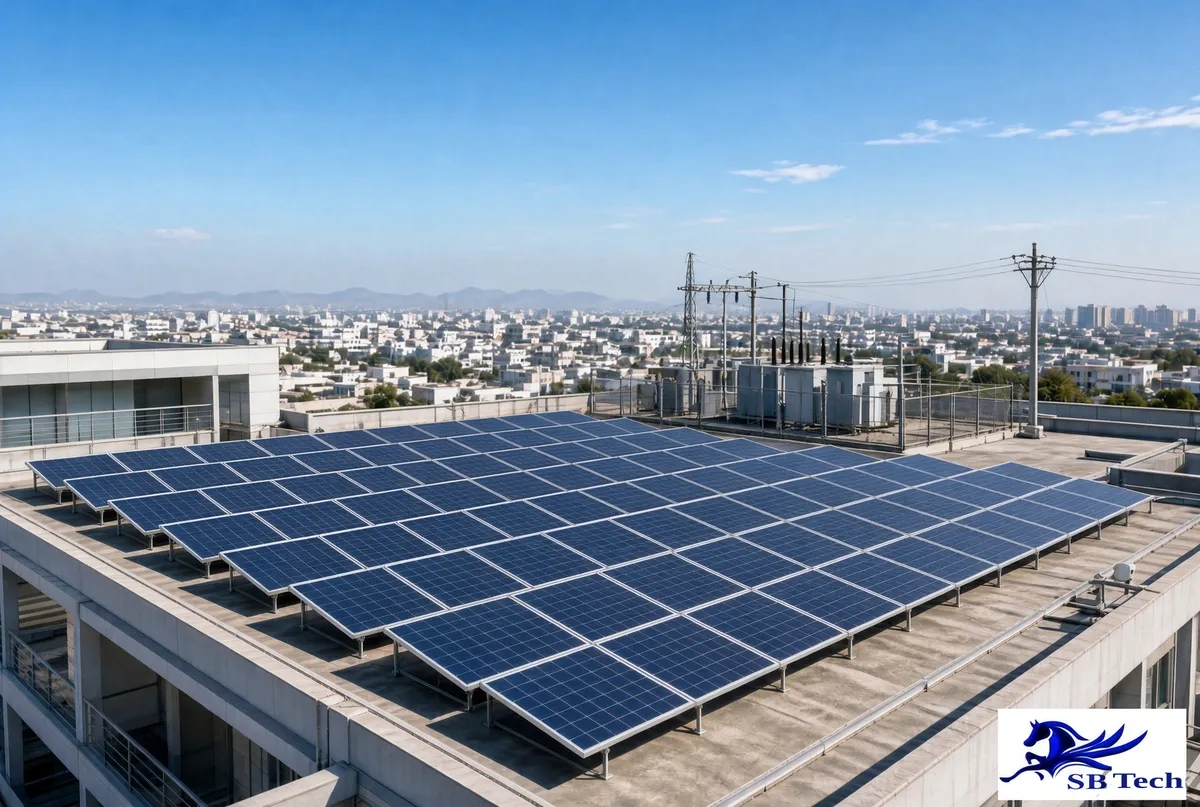
 Illustration
What is a commercial on-grid solar system?
An on-grid (grid-tied) system connects your solar panels to the electricity network through a grid-tied inverter. There is no battery: solar power feeds your loads first, and any surplus is exported to the DISCOM through a bi-directional meter. When sunlight is not enough, the grid supplies the balance automatically. For commercial premises we generally start such systems at 5 kW, because smaller plants rarely make a visible dent in a business bill.
How does it work through the day?
- Generation: panels on the roof or a shed convert sunlight into DC electricity.
- Conversion: the grid-tied inverter turns DC into AC that matches the grid voltage and frequency.
- Self-use first: machines, ACs, lights and computers draw solar power before any grid power.
- Export: extra units go to the grid and are recorded by the net (or gross) meter as per your DISCOM rules.
- Safety shutdown: during a grid outage the inverter switches off (anti-islanding) to protect line workers. This is why pure on-grid systems do not give backup.
Which businesses benefit most?
- Offices, IT and service companies working in daytime shifts
- Showrooms, malls, retail stores and restaurants
- Schools, colleges and coaching centres
- Cold storages, rice mills, workshops and small factories
- Hospitals and nursing homes (often combined with a hybrid section for backup)
Key benefits
- Lowest cost per unit among the four system types, since no battery is required.
- Daytime savings exactly when commercial tariffs and consumption are highest.
- Low maintenance: periodic panel cleaning and inspection are the main tasks.
- Scalable: capacity can be added later as the business grows, subject to sanctioned load and DISCOM approval.
- Tax advantages such as depreciation may be available to businesses under current law; confirm with your CA.
Estimating bill savings the right way
We do not quote a fixed saving figure, because it depends on your tariff category, consumption pattern, roof direction and DISCOM metering rules. A reliable estimate follows these steps:
- Collect 12 months of bills to see units used and the tariff slabs.
- Check how much consumption happens between roughly 9 am and 5 pm.
- Use a planning rule of thumb of about 4 to 5 units per kW per day in good sunlight, then adjust for shading and orientation.
- Value self-used units at your actual tariff and exported units as per the current net or gross metering settlement.
- Compare annual savings with the project cost to get an indicative payback period.
You can start with our solar calculator and then ask SB TECH for a site-specific study.
What to check before you invest
- Shade-free roof area and its structural strength, especially for tin or asbestos sheds
- Sanctioned load and the maximum capacity your DISCOM allows
- Panel and inverter brands, warranties and performance guarantees
- Earthing, lightning protection and cable sizing as per standards
- Remote monitoring and a clear maintenance plan
Environmental impact
Every unit generated on your roof is a unit that does not have to come from a fossil-fuel power station. That reduces your business carbon footprint, supports sustainability reporting and shows customers a visible commitment to clean energy.
Need a commercial on-grid proposal in Hooghly or Kolkata? Call SB TECH on +91-9331161986.
General information for planning only. Regulations, tariffs and tax rules vary by state and change over time; they are confirmed for each project.
Talk to SB TECH about commercial on-grid solar power system
SB TECH, Chinsurah, Hooghly – authorised partner of SolarConnect India.